
Skip to content
Free written estimatesLocal crews
Call now (813) 555-0185
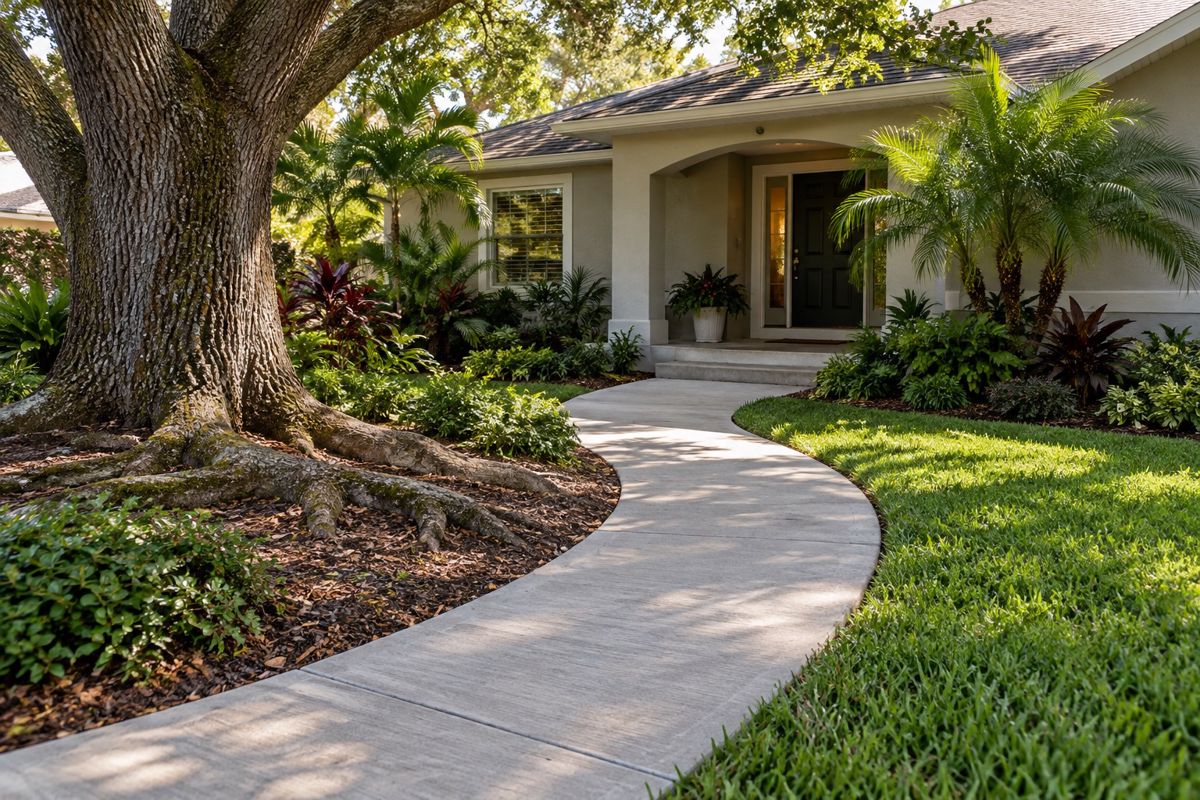
New curved concrete walkway and front steps leading to a Florida stucco home

Walkways in Tampa, FL

Concrete sidewalks Tampa homes need: level, safe and well drained

Front walks, side paths, garden routes and steps, poured flat with the right slope so water leaves and feet stay steady.

  • Front walks, side paths, steps and landings
  • Roots, drainage and slip risks dealt with in the plan
  • Broom finish for grip, or color and pattern if you want it

Step 1 of 3

What do you need?

What counts as a concrete sidewalk or walkway job?

Most walkway jobs on residential lots are one of a few types. A front walk runs from the driveway or the street to the entry door. A side path connects the front yard to the back, often past air conditioning units and trash bins. A garden path leads through landscaping, and a pool path links the lanai to the gate or the driveway.

Steps and landings are part of the same work. They have to follow the building code, which limits riser height and sets a minimum tread depth, so they are safe in the dark and when wet.

A typical home walk is poured three to four feet wide and four inches thick, with a light broom finish for traction. Wider paths feel better for two people walking side by side. We also pour curved paths, which cost more in form work but look good through a landscaped yard. If you also want a new drive, see our driveway page.

What problems affect walkways in Tampa?

Walkways take a lot of abuse from the weather and the trees around them. These are the problems we see most often.

  • Tree roots. Oaks and other large trees lift slabs and create sharp edges that people trip on.
  • Washed-out base. Downspouts and sprinklers carry sand out from under the slab, and it starts to tilt.
  • Ponding. A walk that is flat or slopes toward the house holds water after storms.
  • Algae and mildew. Shade and humidity grow a green film that is slippery underfoot.
  • Uneven joints. Neighboring slabs sit at different heights and form trip edges.

Where a walk is only slightly raised, grinding or lifting may solve it, and you can read about that on our repair and leveling page. Where roots or base failure are the cause, replacing that section with a better base is the lasting fix.

What changes the price of a new concrete walkway?

Walkways look simple, but several details change the final cost. We list each one in your written quote.

  • Total length and width, because the price follows the square footage.
  • Removal of an old walk, and haul-away of the broken pieces.
  • The number of steps, landings or rails.
  • Curves, which need more form work than straight runs.
  • Finish, such as broom, colored, or an stamped pattern.
  • Access, since a walk behind a fence may need a wheelbarrow rather than a truck chute.
  • Tree root cutting, grading changes or added drainage.

If you rent your home or the walk is on a public sidewalk, check with the city or the property owner first. Work in the public right-of-way is not a decision for a single resident, and may need a separate permit. Our home page lists the other services we offer.

A straight front walk is often done in one or two days. The first day covers demolition if needed, grading and forms. The crew then pours and finishes the concrete, usually the same day or the next. Steps and landings take longer because they involve more forms and more careful finishing.

Once finished, the surface needs to be protected as it cures. Most walks can take foot traffic within a day or two. Keep bikes, wheelbarrows and heavy loads off the surface for about a week.

In Tampa summers, the pour is usually scheduled for the morning. This avoids the hottest part of the day and gives the crew time to finish before the afternoon storms arrive. If the forecast changes, we reschedule rather than pour into a storm.

What should you expect on the day, and when should you call?

On the day, the crew marks the path, installs forms, and checks the slope with a level. Water has to run away from the house and off the walk, so we usually aim for a gentle slope across the width. The concrete is poured, leveled, and given a broom finish.

Plan to keep a clear path for your own entry. A temporary board walkway is easy to add if you need to get in and out during the pour. Keep pets away until the surface is firm, and keep sprinklers off for a few days.

Call if a neighbor, delivery driver or guest has tripped, if steps wobble or crumble, or if a path floods after storms. Call before a roof or landscaping project if heavy trucks must cross the walk, so we can plan the order of work.

How it works

  1. Tell us about the project

    Size, finish and goals.

  2. Site visit and quote

    We measure and price it in writing.

  3. Form, pour, finish

    Base, forms and finish done in the right order.

Free written estimates
Local crews
Clear timelines
Site cleanup included

Request walkways and steps

Tell us what you need and we call you back.

No obligation.

Step 1 of 3

What do you need?

Questions about concrete in Tampa

How wide should a concrete walkway be?

A front walk is commonly three to four feet wide. Four feet feels comfortable for two people to walk together. Side paths past utility equipment may be narrower, but they should still allow safe passage. We discuss width during the site visit and mark it out with paint or string so you can see it before the pour.

Why is my concrete walkway lifting near a tree?

Tree roots grow under slabs and push them upward. Over time, the lifted section creates a sharp edge and a trip hazard. Options include grinding the edge, replacing that section and cutting the roots, or rerouting the walk. Only an arborist can say which roots are safe to cut without hurting a tree you want to keep.

Can you make a walkway less slippery?

Yes. A broom finish gives a ridged surface with good grip, and it is the usual choice for walks and steps. Sealers with a slip-resistant additive can help on stamped or smooth surfaces. Regular cleaning removes the algae that makes shaded walks slick. Tell us if the path is wet often or if older people use it.

Do steps have to meet a building code?

Yes. Residential codes limit how high each riser can be and set a minimum tread depth, and larger drops may need handrails. Uniform steps matter because people trip on one that is off by even a small amount. We build steps to the code that applies in your area and can explain the numbers.

Can I replace the public sidewalk in front of my house?

Not on your own. A public sidewalk sits in the city right-of-way, and work there usually needs permission and sometimes a separate permit. Some cities handle repairs themselves or have specific rules for owners. Contact the City of Tampa or your county office first. We can help with the private walk and the path that leads to it.

Ready when you are

Call now or request a quote online.

(813) 555-0185