
Skip to content
Free written estimatesLocal crews
Call now (813) 555-0185
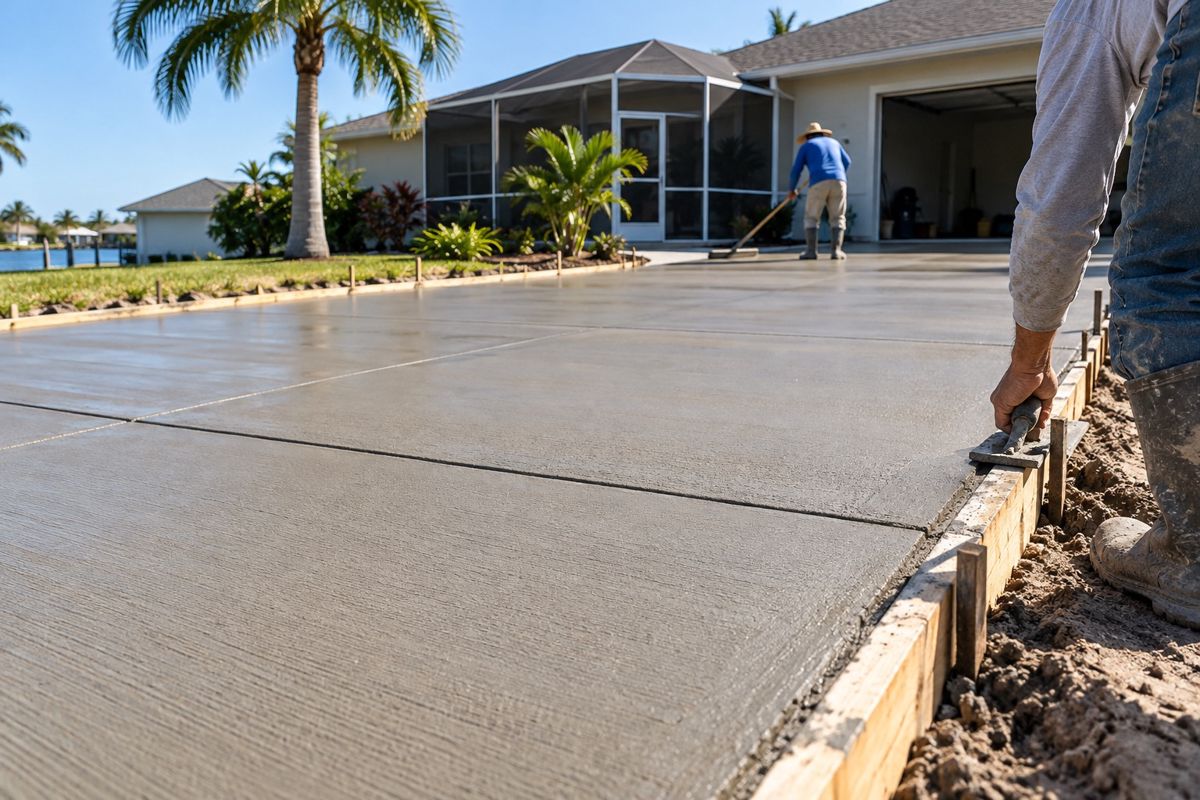
Broom-finished concrete driveway with clean joints beside a Florida stucco home

Driveways in Tampa, FL

Concrete driveway Tampa homes can rely on, new or replaced

We remove the old slab, prepare the base and pour a driveway built for Tampa soil, heat and rain. You get a written quote first.

  • New installs and full replacements
  • Base prep, drainage and joints planned up front
  • Clear timing for when you can drive on it

Step 1 of 3

What do you need?

What does a concrete driveway installation in Tampa involve?

A concrete driveway starts with the ground, not the concrete. The crew marks the shape, removes the old driveway if there is one, and digs out any soft or organic material. Sandy Tampa soil drains well, but it can shift under load if it is not compacted in layers. A base of compacted fill or crushed rock goes down, then forms set the edges and the slope.

Most home driveways are poured four inches thick. If you park a heavy truck, a trailer or an RV, ask about five or six inches. Reinforcement is the next choice: fiber in the mix, welded wire or steel rebar on a grid. Control joints are cut or tooled in so the slab cracks along straight lines you chose, not across the middle of your parking spot.

For a wider view of what we do around the area, start on the Tampa Concrete Experts home page.

What problems do Tampa driveways run into?

Most failed driveways here trace back to a few causes. Knowing them helps you judge a quote.

  • Poor base. Loose sand under the slab washes out, and corners start to sink.
  • Water with nowhere to go. Downspouts and sprinklers that soak the edge of the slab undermine it over time.
  • Tree roots. Large oaks and other trees push up the slab and open wide cracks.
  • Missing joints. Without control joints, heat and shrinkage crack the surface at random.
  • Stains and algae. Shade and humidity grow green film that makes the surface slick.

A good plan deals with each of these before pouring. That may mean trimming roots, adding a drain line, changing the slope or adding a sealer. If your slab is cracked but still level, a repair may be enough and can save you a full replacement.

What changes the price of a new concrete driveway?

We do not quote by phone, because the size and the condition of the site decide most of the cost. These are the main factors.

  • Total square footage and the shape of the drive, since curves and angles take more form work.
  • Demolition and haul-away of the old driveway, including thick or heavily reinforced slabs.
  • Thickness, mix strength and reinforcement.
  • Finish, such as a broom finish, a colored slab, or an stamped or decorative border.
  • Access for the concrete truck, and whether a pump is needed.
  • Drainage work, tree root removal and any grade changes.
  • Permits, especially if the apron at the street is part of the job.

Written quotes from different contractors are only comparable if they list the same thickness and reinforcement, so check those lines first.

Most single-family driveways take about three to five working days from start to pour, with weather as the main variable. Day one is usually demolition and haul-away. Day two is grading, compacting the base and setting forms. Reinforcement goes in just before the pour.

Pour day is the longest day. Concrete has a limited window in which it can be placed, screeded and finished, so the whole crew works steadily. Joints are cut within the first day or so, once the surface can take it.

After that comes cure time. You can usually walk on the driveway the next day or two. Cars should wait about a week, and heavier vehicles a little longer. We give you exact dates for your job, because summer heat and cooler winter days change the schedule.

What should you expect on pour day, and when should you call?

Move cars off the street or out of the garage the evening before, and make sure sprinklers are switched off. The ready-mix truck arrives at a set time, and the crew places the concrete, levels it, floats it and finishes it. If rain is close, we may move the pour rather than risk the surface.

Keep children and pets away from the forms. Do not drive on it, and do not let water from a hose or sprinkler sit on the fresh surface.

Call when you see cracks wider than a quarter inch, edges that sink, slabs that tilt toward the house, or water pooling after storms. Call before you buy decorative materials too, so the pattern, color and slope are planned together. For walkways that meet your driveway, see our walkways and steps page.

How it works

  1. Tell us about the project

    Size, finish and goals.

  2. Site visit and quote

    We measure and price it in writing.

  3. Form, pour, finish

    Base, forms and finish done in the right order.

Free written estimates
Local crews
Clear timelines
Site cleanup included

Request concrete driveways

Tell us what you need and we call you back.

No obligation.

Step 1 of 3

What do you need?

Questions about concrete in Tampa

How thick should a concrete driveway be in Tampa?

Four inches is the usual thickness for cars and light trucks. If you park a heavy pickup, a trailer, a boat or an RV, five or six inches is safer. Thickness works together with the base and reinforcement, so a thicker slab on a poor base can still fail. We list thickness and reinforcement in the written quote so you can compare.

Do I need a permit to replace a driveway in Tampa?

Often, yes, especially when the work touches the apron where the driveway meets the street. Rules differ between the City of Tampa and unincorporated Hillsborough County, and also with HOA guidelines. We ask for your address on the first call and tell you what to confirm with the local office before work starts.

How soon can I drive on a new concrete driveway?

Walking is usually fine after a day or two. Passenger cars generally wait about seven days. Heavy trucks, trailers and delivery vehicles should wait longer, close to the 28 days it takes concrete to reach most of its strength. We give you a specific date based on the mix and the weather during your pour.

Why do driveways crack, and can cracks be prevented?

Concrete shrinks as it dries, so some cracking is normal. Control joints guide cracks into straight lines, and a well-compacted base keeps them from widening. Heat, heavy loads, tree roots and poor drainage make them worse. You cannot prevent every hairline crack, but you can avoid wide, uneven ones with good preparation.

Can you pour a new driveway over the old one?

Sometimes a thin overlay works if the old slab is level, solid and only worn on the surface. If it has sunk, heaved or cracked through, an overlay will fail and the cracks will return. We look at the slab on the site visit and tell you whether resurfacing or full replacement makes more sense.

Will tree roots damage my new driveway?

They can. Large roots grow under slabs and lift them over time. A root barrier, careful trimming and a slightly thicker slab can help, but only an arborist can say what is safe for a tree you want to keep. Tell us about nearby trees at the site visit so the plan accounts for them.

Ready when you are. Call now or request a quote online.